

FANTOM Web Resource update 2025
We are pleased to announce the publication in Nucleic Acids Research Database Issue 2025, describing major updates to the FANTOM web resource that broaden functional annotations and tools for exploring mammalian noncoding genomes. The update adds curated functional information for long noncoding RNAs (including data from iPS cells), chromatin-interaction–based annotations of nuclear lncRNAs, and a newly assembled catalog of transcriptionally active cis-regulatory elements to accelerate research into transcriptional regulation. See also its supplemental landing page.
(doi:10.1093/nar/gkae1047)

fanta.bio: Expanded FANTOM5 Promoter and Enhancer atlases
fanta.bio (Functional genome ANnotations with Transcriptional Activities) collects functional genomic elements of transcriptional activation, focused on cis-regulatory elements (CREs) by leveraging transcriptional signatures detected with CAGE and related protocols to capture 5'-ends of RNAs. Unlike resources that infer CREs from chromatin marks alone, fanta.bio identifies genomics elements around which transcripts are actively transcribed (e.g. mRNA, lncRNA, eRNA, uaRNA). Each CRE region has annotations with activity levels, neighboring genes, and links to genetic variation and TF-binding resources. The resource was built to extend the FANTOM5 promoter/enhancer atlases with FANTOM6 CAGE profiles and newly generated CAGE datasets.
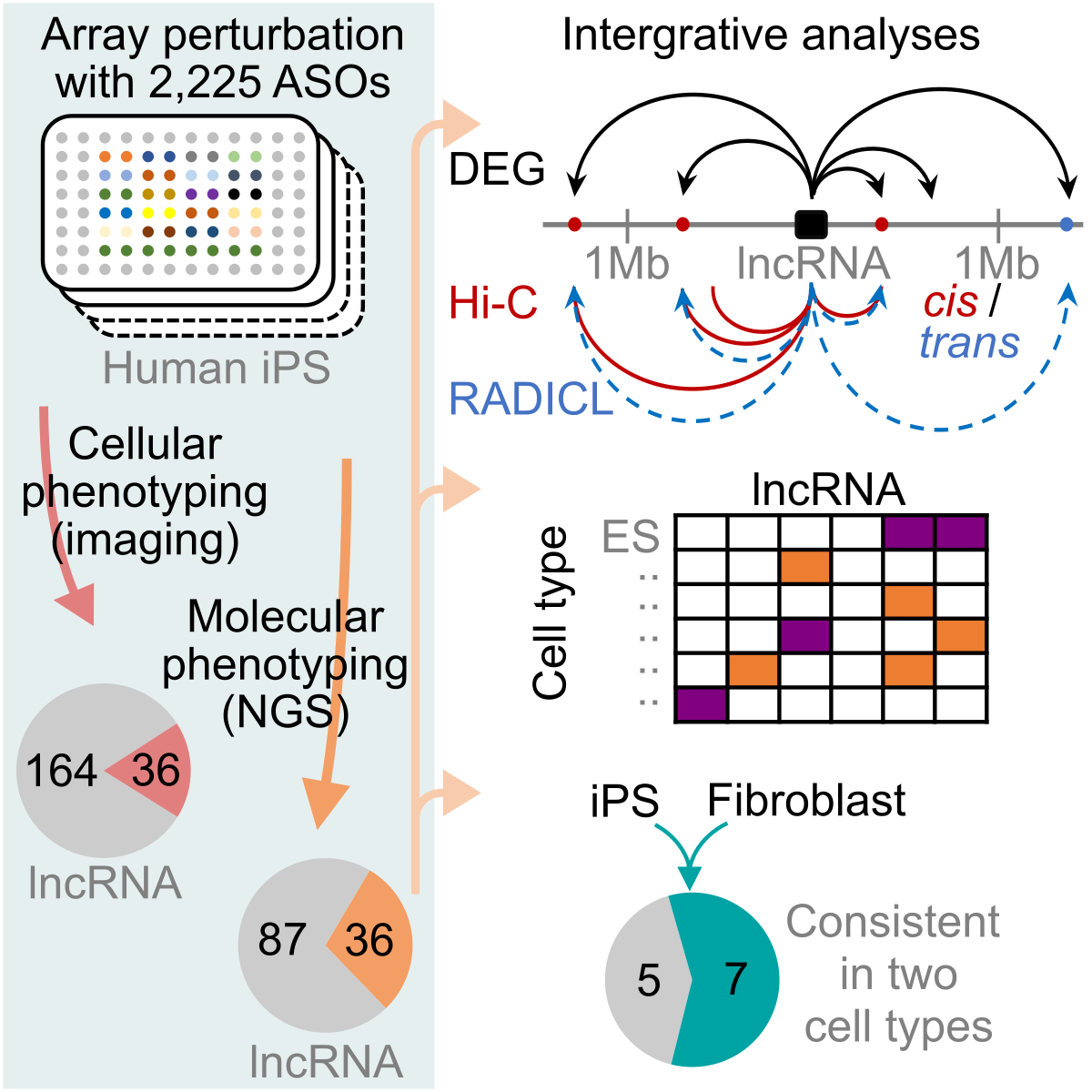
FANTOM6 iPSC lncRNA paper is published!
We perform a large-scale knockdown of 200 long non-coding RNAs (lncRNAs) in human induced pluripotent stem (iPS) cells and find 36 lncRNAs (18%) exhibiting cell growth inhibition. From the knockdown of 123 lncRNAs with transcriptome profiling, 36 lncRNAs (29.3%) show molecular phenotypes. Integration with chromatin-interaction assays further reveals cis- and trans- interacting partners as potential primary targets. Additionally, cell type enrichment analysis identifies lncRNAs associated with pluripotency. We compare our results with previously published fibroblasts phenotyping data and find that 2.9% of the lncRNAs exhibit consistent cell growth phenotype, whereas we observe 58.3% agreement in molecular phenotypes. This highlights the consistency of lncRNA function at the molecular level and molecular phenotyping is more comprehensive in revealing affected pathways.
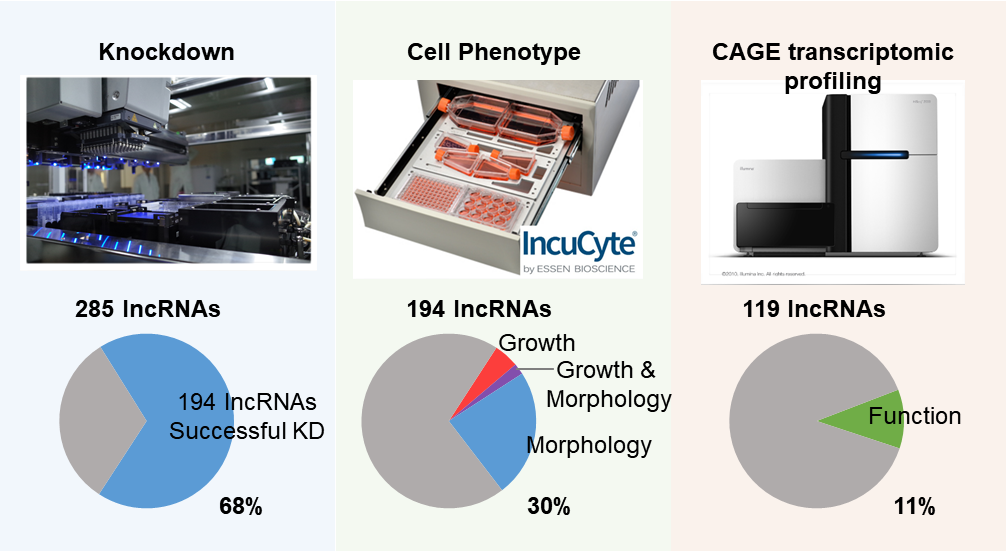
FANTOM6 pilot analysis paper is published!
We published a pilot study of FANTOM6, the latest edition of the project, looking at human long non-coding RNAs, which outnumber protein-coding genes in mammals but whose function is still poorly understood. We selectively targeted nearly 300 long non-coding RNAs for suppression in human fibroblast cells using an automated robotics system, and combined live cell imaging with CAGE to observe how cells respond at both the cellular and the molecular level. Based on the analysis, over 25 percent of long non-coding RNAs were found to affect cell growth and morphology, as well as cell migration.

The FANTOM5 collection on NPG
A collection of articles, including research papers and data descriptors, on the FANTOM5 project published in the Nature Publishing Group (NPG) is provided here .
This is also picked up by
RIKEN’s web site.
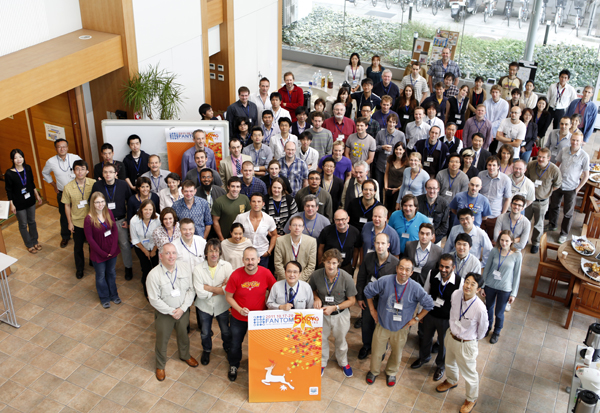
FANTOM5
In FANTOM5 we are expanding the efforts made in FANTOM3 and 4 and aim to generate both a map of the majority of human promoters and comparative transcriptional regulatory network models of each cellular state. To achieve this we are carrying out deepCAGE sequencing on the Heliscope true single molecule sequencer on RNA isolated from every major human organ, over 200 cancer cell lines, 30 time courses of cellular differentiation, mouse developmental time courses and over 200 primary cell types.
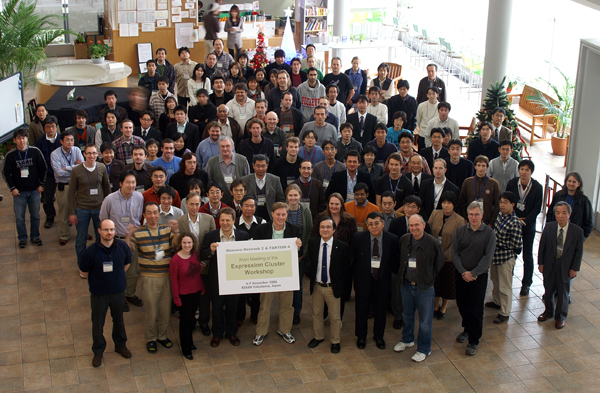
FANTOM4
FANTOM4 used deepCAGE to monitor the dynamics of transcription start site (TSS) usage during a time course of monocytic differentiation. The expression levels from each promoter and transcription factor binding site predictions were then used to build a transcriptional regulatory network model (Suzuki et al. 2009). Additionally, transcription intitiation RNAs, the expression of the 'repeatome' and at atlas of combinatorial TF regulation were published in FANTOM4.
FANTOM3
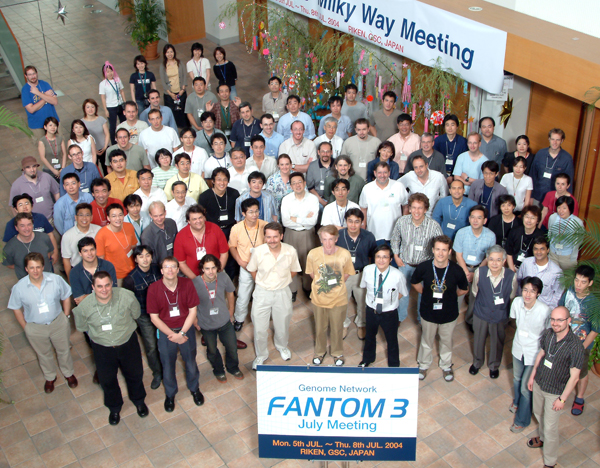
FANTOM consortium utilized a new technology, CAGE, to reveal that more than 63% of the genome — instead of the known ~1.5% fraction of protein coding exons — is transcribed as RNA. We also confirmed the existence of over 23,000 non-coding RNAs (ncRNAs) and that >73% of the transcriptional units show sense-antisense transcription. This work was published in a couple of papers in the “RNA special issue” of Science in 2005 (Carninci et al. 2005; Katayama et al. 2005)
FANTOM2
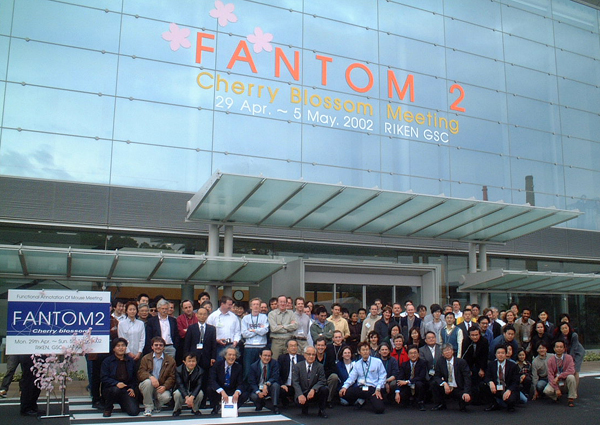
During the second phase of the FANTOM activities, we determined the base sequences and assigned functional annotations to a set of 60,770 full-length mouse cDNAs. This was the first project worldwide to standardize full-length mammalian cDNAs. The research was published in a special issue of Nature on the decoding of the mouse genome in 2002 (Okazaki et al. 2002)
FANTOM1
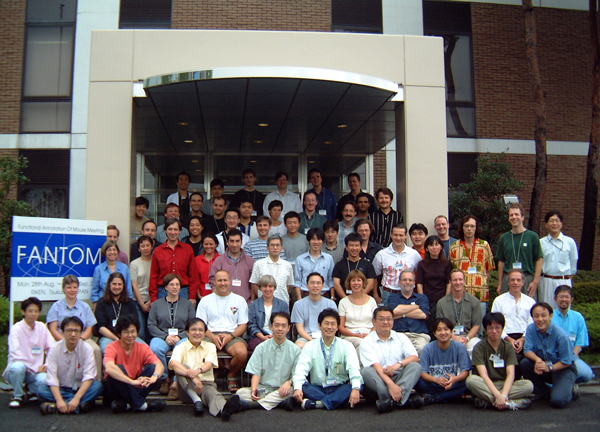
The consortium developed an effective system for functional gene annotation by designing appropriate rules and methods. The result was mainly published in Nature in 2001(Kawai et al. 2001). The paper was followed by the draft sequence of human genome (Lander et al. 2001) week later because they used our cDNA for gene number prediction.
FANTOM
FANTOM is an international research consortium established by Dr. Hayashizaki and his colleagues in 2000 to assign functional annotations to the full-length cDNAs that were collected during the Mouse Encyclopedia Project at RIKEN. FANTOM has since developed and expanded over time to encompass the fields of transcriptome analysis. The object of the project is moving steadily up the layers in the system of life, progressing thus from an understanding of the ‘elements’ - the transcripts - to an understanding of the ‘system’ - the transcriptional regulatory network, in other words the ‘system’ of an individual life form.
FANTOM is now in the 6th edition of the project. Project page of each edition is available below:
- FANTOM6 - Functional analysis of non-coding RNAs
- FANTOM5 - Atlases of mammalian promoters, enhancers, lncRNAs and miRNAs
- FANTOM4 - Understanding the transcriptional regulatory network
- FANTOM3 - Transcriptional landscape of mammalian genome
- FANTOM2 - Functional annotation of ~60,000 mouse full-length cDNA collection
- FANTOM1 - Initial functional annotation of ~20,000 mouse cDNA collection

Simultaneously with producing data, FANTOM established the FANTOM database and the FANTOM full-length cDNA clone bank, which are available worldwide. The FANTOM resources have been used in several important research projects. For instance, the full-length cDNA database was used in a computer prediction of the genomic position (transcriptional unit) of genes by the International Human Genome Sequencing Consortium. Also they have been used by a research group led by Dr. Shinya Yamanaka at Kyoto University, Japan, for establishing Induced pluripotent stem (iPS) cells. In the study, 24 transcription factors were selected from FANTOM database as candidate initiation factors. Furthermore, the Allen Institute for Brain Science in the United State has created a digital atlas that encompasses the whole brain, and has made it publicly available. The atlas graphically illustrates the expression of genes within the mouse brain using Informatix software. This project has also made use of the FANTOM database.